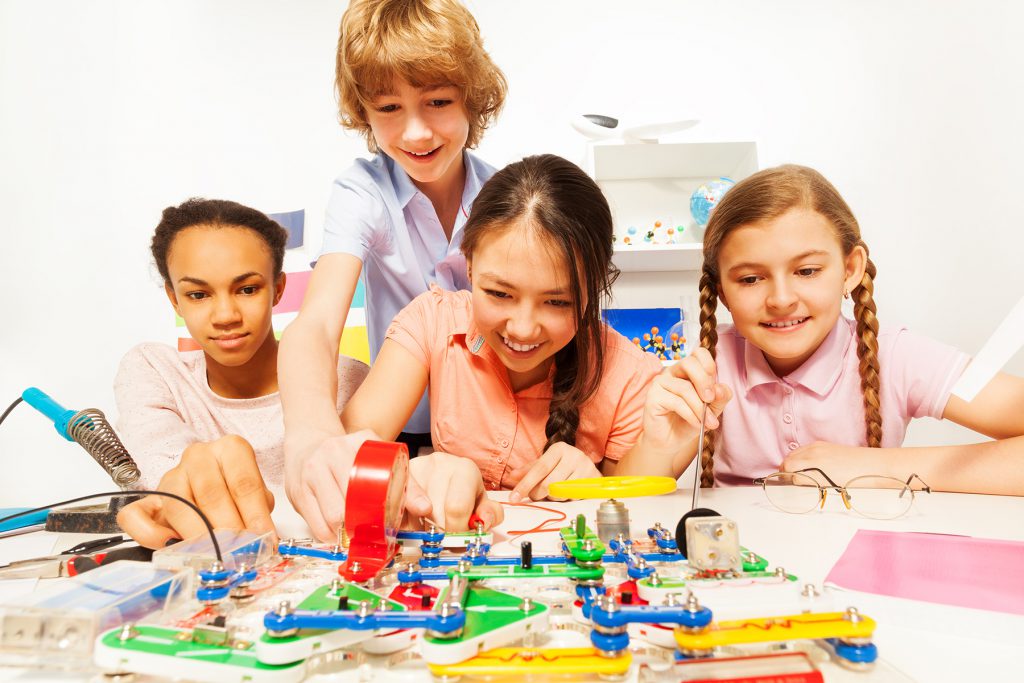
Makerspace is a place where people come together to use and learn to use materials and develop creative projects, it has the potential to revolutionise the way we approach teaching and learning (Kurti, Kurti & Fleming 2014). Makerspace in education is built upon the pedagogy principals of constructionism, students learn through hands on play and creating, students rather than the teacher initiate the learning process. Makerspaces are commonly associated with using technology to create and design and will:
- Foster play, exploration, and participatory learning
- Facilitate informal learning opportunities where connections between home, school, and community are enabled and encouraged.
- Collaborative learning where teachers and students pool their skills and knowledge and share in the tasks of teaching and learning.
Makerspaces make use of the access to technology that improvements to manufacturing have afforded. Digital fabrication devices such as 3D printers and programs including MaKey MaKey, and Raspberry Pi are great examples of the use of technology in Makerspaces to expand a student’s skills giving them new ways to make things or new things to make. There is no set list of tools, equipment or programming required. A 3D printer might be a great example of a Makerspace tool, but equally Makerspaces can be created around low tech and low-cost options such as conductive thread and play doh, or even simply duct tape, there are no fixed materials and tools but a mindset of creativity and collaboration.
Makerspaces are only successful in supportive environments, there is no amount of bright, shiny new technology that can take the place of inspiration, and inspiration is a direct result of the environment created by the space (Kurti, Kurti & Flemming 2014).
The best way to activate a classroom is for students to make something. This might an amazing hightech invention or it might take the form of costumes for a historical reenactment, homemade math manipulatives, toys, a pet habitat, a messy science experiment, or many other things (Stager 2016).
Ultimately, markerspaces used in education leads to determination, independent and creative problem solving, and an authentic preparation for the real world by simulating real-world challenges
References
Kurti, S., Kurti, D. & Fleming, L. 2014. The Philosophy of Educational Makerspaces. Techer Librarian, 14 (5) : 8-11.
Stager, G. 2016. What’s the maker movement and why should I care?. Scholastic. http://www.scholastic.com/browse/article.jsp?id=3758336\&print=2


Hi Christina!
A great post explaining Makerspaces and how the environment can be integrated into education to foster learning through creativity, design and collaboration. It was interesting to read about how different technologies could be integrated within Makerspaces to enhance the hands-on learning experience of students and further develop their capabilities. I also enjoyed how you included low-cost options for materials, tools and resources that could be included in a Makerspace to make it accessible to different schools and educational facilities. The link between Makerspaces and the pedagogical principle of constructionism was also very relevant and I believe it is a broad area that can be expanded upon. This was an overall concise and interesting post to read! Thanks!
Jiajin Han.
LikeLike