
Augmented Reality (AR), is the bridging of virtual and real worlds, creating a reality that is enhanced and augmented. AR is a technology that overlays interactive digital elements for example images, video clips and animations into real world environments. AR provides exciting possibilities for teaching and learning. The coexistence of virtual objects and real-life environments allows students to visualise complex spatial relationships and abstract concepts and experience things that is not possible in the real world (Wu, Lee, Chang & Liang. 2013).
AR in Education
AR technologies encourages students to engage in authentic exploration of the real world and virtual objects, it can be used to integrate the real world and digital learning resources in any level of education from pre-school through to University. Here is just some examples:
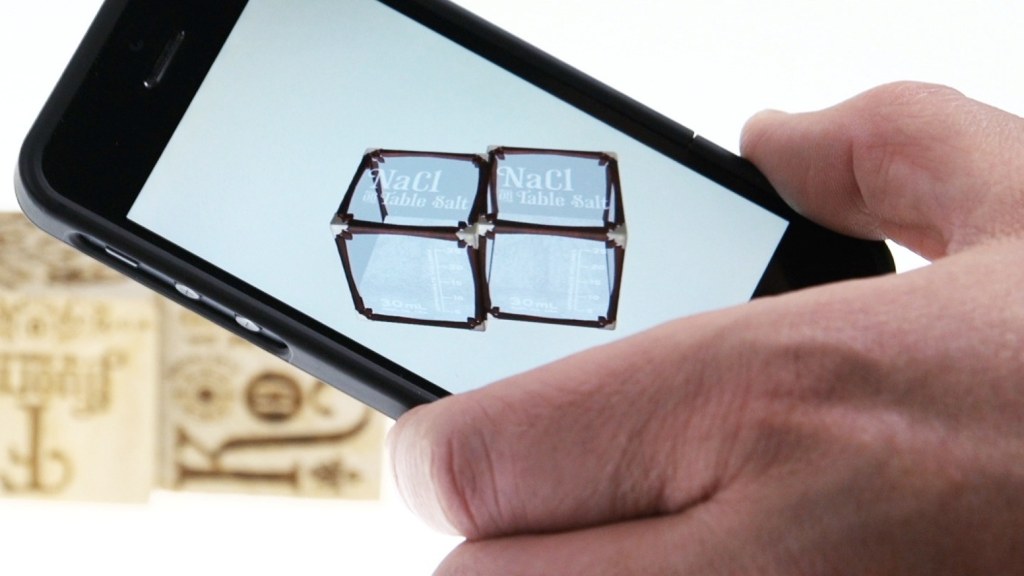
Science – AR enables students to experience scientific phenomena that otherwise unable to experience in the real world
Elements 4D It allows combining different chemistry elements to see how they would react in reality.
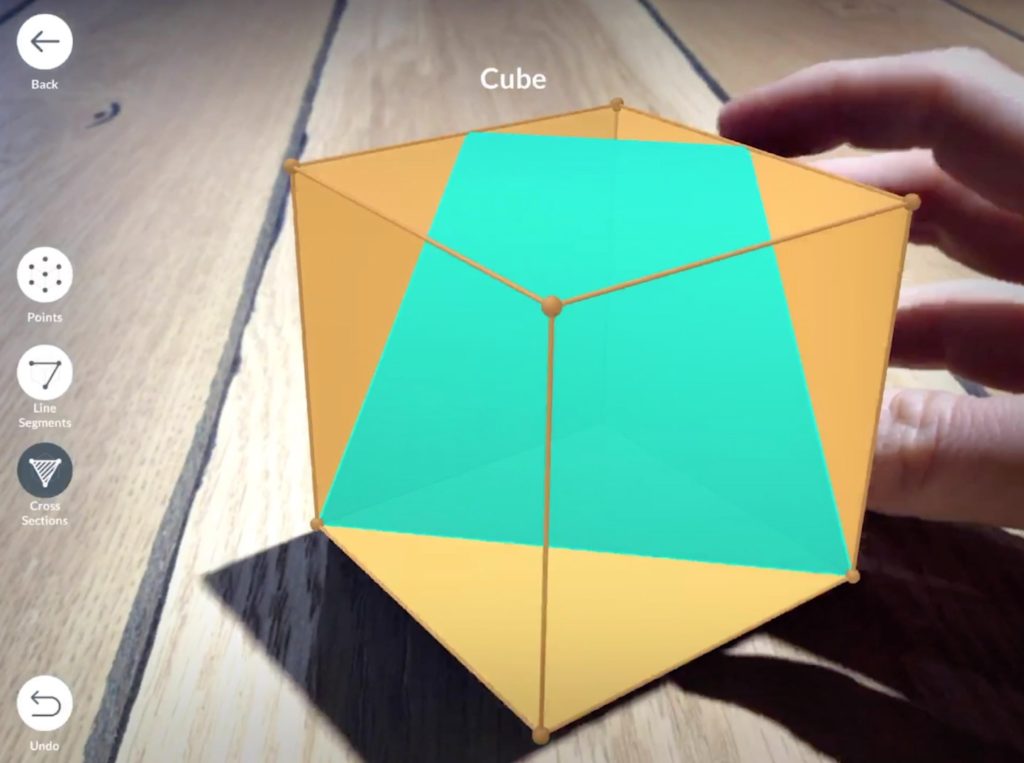
Mathematics – AR engages students in manipulating virtual materials from a variety of perspectives
3D Geometry students measure and manipulate 3D objects in order to understand spatial relationships.
Literacy – AR provides students with a pop-up book experience of visualising the content to enhance students’ understanding of abstract concepts.
Animal Alphabet AR Flashcards an app for learning letters, the application brings cards “into life” by showing live animals

Advantages
AR can enhance learning experiences by virtually manipulating learning objects to enhance their understanding. It can increase students’ motivation and interest and be used in implementing inquiry-based learning within the classroom. AR technologies can be used on different handheld devices, as a result, education becomes more accessible and mobile. The mobile AR system can enable ubiquitous, collaborative and situated learning, enhanced by computer simulations, games, models and virtual objects in real environments. Social interactivity can be enhanced when student collaborate through networked devices and provided scaffolding customised to different paths of investigations promotes individuality (Ketelhut. 2010). AR also promotes presence, immediacy and immersion. It provides a mediated space that gives the student a sense of being in a place with others which enhances students’ recognition of the community of learners. It can also provide feedback to enhance students’ sense of immediacy.
Disadvantages
Using handheld devices can sometimes cause students to be distracted from the task on hand. Without a well-designed program to guide students’ actions, students could have difficulties in interpreting the clues in the devices and the real-world environment. The inflexibility of the content in some of the AR systems can cause a pedagogical issue, content and teaching sequences that are fixed are unable to be changed accommodate students’ needs. Some AR technologies may require students to apply multiple complex skills this may be a challenge for some students that lack skills such as collaboration, problem solving and technology manipulation.
References
Ketelhut, D,J. 2010. Review: Eric Klopfer: Augmented learning : Research and design of mobile educational games. Journal of Science Education and Technology. Vol 19 (2): 212-214. Accessed 13 April 2020, www.jstor.org/stable/40607096
Wu, H., Lee, S,W., Chang, H., & Liang, J,C. 2013. Current status, opportunities and challenges of augmented reality in education. Computers & Education. Vol 62: 41-49. Accessed 10 April 2020. https://www.sciencedirect.com/science/article/pii/S0360131512002527


Hi Christina, i really enjoyed your post! I liked that you have clearly outlined the advantages and disadvantages of the technology so clearly to allow for readers to understand your perspective and take that into consideration when implementing within their own classrooms. I also liked that you gave numerous examples as to how this technology can be used in multiple KLA’s. I particularly think using the technology for mathematics could be an exciting way for students to engage and enrich their mathematical understanding!
LikeLike
Hi Christina, you raise some very good points about disadvantages including distractions and inability to understand content. It is good you observe the advantages of AR being an immediate and immersive form of learning. I enjoyed looking at the how AR can be used in math and science. I feel you could link your concepts more to how VR can foster students creativity and its implications, however on the whole quite a refined response.
LikeLike